United Kingdom · guide · 22 September 2026
Drainage, flood risk, and SUDS conditions on UK planning decision notices
Drainage on a planning decision notice is rarely one sentence. It may be a compliance-only line building to drawings already on the file, a pre-commencement condition reserving SuDS details, a flood risk assessment to be approved before start, or a during-works submission before hard surfacing goes in. The expensive mix-up is treating "drainage approved with the application" as permission to ignore later FRA limbs, or assuming every drainage line needs a discharge when the notice simply names binding drawings. This guide is reading literacy: how to classify drainage, flood risk, and SuDS wording on the sealed notice.
This page is informational. It is not planning advice, not discharge-application writing, and not drainage or flood risk consultancy. Always read the sealed decision notice. Public sector information on samples is reused under the Open Government Licence v3.0.
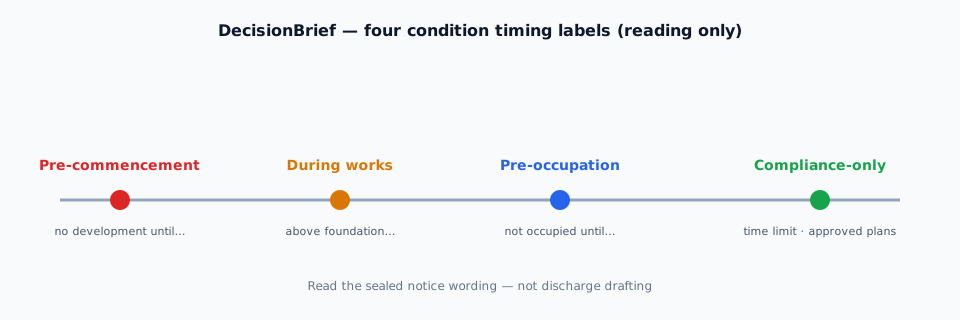
Four drainage wording patterns on decision notices
Local planning authorities use several distinct forms. Read the trigger in each numbered line — do not assume all "drainage" conditions behave the same way.
- Build to submitted drainage drawings — "The development shall be carried out in accordance with the details shown in the submitted Drainage Assessment… and Drainage Layout…" Often compliance-only: the assessment is already on the planning file; you implement unless otherwise agreed in writing.
- Details reserved before commencement — "No development shall take place until a surface water drainage scheme… has been submitted to and approved in writing." Classic pre-commencement; common on brownfield or high run-off sites.
- Stage-triggered approval — "Prior to the laying of any hard surfacing…" or "prior to first occupation of the building…" Usually during works or pre-occupation, depending on the exact trigger.
- Flood risk assessment (FRA) limbs — separate numbered conditions requiring an FRA, sequential test, or exception test evidence where national policy applies. Timing varies; read whether approval is required before commencement or before occupation in flood zones.
On the York Hempland sample, condition 5 is compliance-only: build in accordance with named drainage assessment and layout revisions dated 30 June 2025, unless otherwise agreed in writing. No prior approval step is described on the face of that condition. That is different from a permission that bars commencement until a SuDS scheme is approved.
SuDS and surface water: planning condition vs other regimes
Sustainable Drainage Systems (SuDS) may appear in planning conditions, in approved drawings listed under an approved plans condition, or in informatives pointing to separate approval routes. Since 6 April 2015, major development drainage systems in England have also been subject to SuDS approval under Schedule 3 to the Flood and Water Management Act 2010 (where the county council or unitary authority acts as SuDS approving body). Planning permission and SuDS approval are related but not identical.
A planning condition might require attenuation crates, permeable paving, or discharge rates to be shown in a scheme approved before commencement. An informative might remind you that Building Regulations Part H and sewer connection consent from the water company are separate. DecisionBrief follows what the sealed notice numbers and cites; we do not treat unnumbered informatives as extra conditions. See informatives vs numbered conditions.
GOV.UK guidance on use of planning conditions says conditions should be necessary, relevant, enforceable, precise, and reasonable. For drainage, that often means tying the condition to a specific run-off standard or named drawing set rather than vague " satisfactory drainage" without a trigger. That is drafting guidance for authorities; your reading task is to spot whether the council's sentence requires submission, approval, or simply compliance with listed documents.
Flood risk conditions: read the trigger, not the zone map alone
Flood risk wording on notices often references Environment Agency flood zones, the sequential test, the exception test, or finished floor levels relative to a design flood level. A permission in Flood Zone 2 or 3 may carry an FRA condition even when a drainage assessment was submitted with the application — the FRA condition may reserve further details if the layout changes, or require evidence before occupation.
Read each numbered line for its own trigger:
- "Prior to commencement… FRA submitted and approved" — pre-commencement barrier.
- "The development shall be carried out in accordance with the FRA dated…" — may be compliance-only if no approval step is stated.
- "Prior to occupation… flood evacuation plan…" — pre-occupation, even if drainage works finished earlier.
- "Finished floor levels shall be no lower than…" — often compliance-only ongoing duty during build and after.
Do not merge FRA, drainage layout, and SuDS maintenance conditions into one "water package". DecisionBrief lists and classifies each numbered line separately, using the four labels in how to read condition timing.
| Typical council wording | DecisionBrief label | Discharge application? |
|---|---|---|
| "Carried out in accordance with submitted Drainage Assessment Rev D…" | Compliance-only | Usually no — build to listed docs |
| "Prior to commencement… drainage scheme approved in writing" | Pre-commencement | Yes — submit scheme for approval |
| "Prior to laying of hard surfacing… SuDS details approved" | During works | Yes — before that stage |
| "Shall not be occupied until drainage connections complete" | Pre-occupation | May need approval or simply works on site |
| "Informative: seek sewer connection from Yorkshire Water" | Unnumbered note | Separate regime — not condition 23 |
Mix-ups applicants make most often
- Assuming drainage on the application file means no condition applies. The notice may still number a drainage line, an FRA, or a maintenance plan for SuDS features. Read the sealed schedule.
- Treating "unless otherwise agreed in writing" as optional. Compliance-only drainage conditions still bind you to the named drawings until the authority agrees a change in writing.
- Ignoring maintenance and adoption wording. Some conditions require a maintenance plan, funding mechanism, or adoption strategy for SuDS features — often pre-commencement or pre-occupation, not the same as the layout drawing condition.
- Confusing planning drainage with sewerage undertaker consent. An informative about Section 106 sewer agreements or Build Over agreements is a pointer to another regime. See Section 106 vs conditions if obligation wording appears.
- Skipping FRA conditions because a drainage assessment was submitted. FRA and surface water drainage answer different policy tests. Both may appear as separate numbered lines.
Approved drawings and drainage schedules
Drainage often binds through an approved-plans condition listing drawing numbers, or through a dedicated drainage condition naming assessment and layout revisions. Check whether the notice lists the same drawing set in condition 1 (approved plans) and again in a later drainage-specific condition. DecisionBrief cites each numbered line; we do not deduplicate them in the PDF if the notice numbers both.
If the sealed notice is thin — conditions listed without drawing schedules — compare the register PDF to the officer report. See thin or missing sealed decision notice and decision notice vs officer report for which document binds when they differ.
What DecisionBrief does (and does not do)
The £79 PDF lists every numbered condition we can source, classifies drainage, FRA, and SuDS lines by trigger timing, and cites the council wording so you can see whether you build to submitted drawings or must obtain written approval first. We note when drainage appears only in an unnumbered informative on the report we opened. We do not invent numbered conditions from notes.
For conditions requiring written approval, see which conditions need a discharge application. We classify; we do not prepare drainage strategies, FRAs, or SuDS design packages.
What a £79 DecisionBrief PDF is (and is not)
You paste the public URL of a named UK planning decision notice. We send a PDF in 24 hours that states the permission in plain English, lists every numbered condition we can source, classifies each by trigger timing, and cites the council wording. Neighbour personal names are redacted. If the notice is thin or differs from the report, the PDF says so. If we cannot read a public decision, we refund.
What it is not
- Not planning advice. We do not say whether your drainage scheme complies or whether to appeal a condition.
- Not discharge drafting. We do not write drainage assessments, FRAs, SuDS maintenance plans, or micro-drainage calculations.
- Not SuDS approving body advice. We do not lodge Schedule 3 applications or negotiate sewer adoption.
- Not a search engine. You already have the notice; we read the one you send.
Order a £79 sourced reading See the York sample first
Related guides
- How to read condition timing — four labels with York wording patterns.
- Approved plans conditions — when drainage binds via drawing schedules.
- Informatives vs numbered conditions — sewer and Build Regs reminders.
- Which conditions need a discharge application — submit-and-approve wording.
- Pre-commencement vs pre-occupation — when FRA bites before occupation not before start.
Questions
What is the difference between a drainage condition and a flood risk assessment condition?
A drainage condition usually controls how surface water leaves the site — often via SuDS, soakaways, attenuation, or connection to the public sewer — and may require details approved before commencement or build to drawings already on the file. A flood risk assessment (FRA) condition typically reserves further details where the site is in a flood zone or affects drainage catchments, requiring an FRA or sequential test evidence to be submitted and approved. Read each numbered line separately; one permission may have both.
When is drainage compliance-only rather than pre-commencement?
If the condition says the development shall be carried out in accordance with named drainage drawings or a drainage assessment already submitted, with no prior-to-commencement approval step, DecisionBrief usually labels it compliance-only: build to those documents unless otherwise agreed in writing. If the condition says no development until a drainage scheme or SuDS details are submitted and approved, it is pre-commencement.
Do SuDS conditions replace sewer adoption or water company approval?
No. Planning conditions address the planning permission. Separate consents may still be needed from the sewerage undertaker, the lead local flood authority, or under the SuDS approval regime where applicable. An informative about Building Regulations Part H or sewer connection is a reminder of a separate regime, not an extra numbered planning condition unless the notice numbers it.
Can drainage appear in both condition 1 and a later condition?
Yes. An approved-plans condition may list site layout drawings while a later line names drainage assessment and layout revisions specifically. DecisionBrief cites each numbered line the notice contains; we do not merge them unless the notice itself does.
Is this planning advice?
No. This guide and the £79 PDF are sourced readings of public notices. The council's decision notice remains the legal document. If you need drainage or flood risk advice, instruct a suitably qualified consultant or solicitor.
Will you write the drainage scheme or FRA?
No. We classify the conditions and cite the wording. We do not prepare or lodge discharge applications or hydraulic calculations.
Who runs DecisionBrief?
Ellis Greensitt, sole trader, trading as DecisionBrief. English law. See terms and privacy. Email hello@decisionbrief.co.uk. No telephone.
Sources cited on this page: GOV.UK — Use of planning conditions; Planning Portal — conditions and obligations; GOV.UK — Flood risk assessment for planning applications; DecisionBrief sample for City of York 25/01211/FUL, 45 Hempland Lane (condition 5 drainage as submitted). Last reviewed 22 September 2026. DecisionBrief is not City of York Council and is not the Planning Portal.