United Kingdom · guide · 5 September 2026
Decision notice vs officer report vs committee minutes — which document binds you?
When a planning application is decided you often get three public papers: an officer report, committee minutes, and a decision notice. They look as if they say the same thing. They do not. The expensive mistake is treating a recommendation, or a vote, as the permission. This guide sets out which document binds you, with a live York sample where the sealed notice could not be opened from this desk.
Three documents, three jobs
The officer report is the case officer’s analysis and recommendation. On a committee case it is the paper members had in front of them. It usually prints the conditions the officer wants attached if permission is granted, and a set of informatives — notes, not numbered conditions. The Planning Advisory Service records that written notice of the decision is required by article 35 of the Town and Country Planning (Development Management Procedure) (England) Order 2015, and that the legislation does not require that notice to include an officer report. The report shows how the issues were weighed. It is not the grant.
Committee minutes record what the meeting did: approve, refuse, defer, or amend. They are the formal record of the resolution and of any amendment that was put. They almost never reprint the condition schedule. They are a fact about the vote, not the wording issued to the applicant.
The decision notice is the written notice the local planning authority must give the applicant. GOV.UK guidance on determining a planning application (paragraph 019) says the authority “must formally notify the applicant of their decision using a written decision notice.” Paragraph 020 points to article 35 of the 2015 Order for what that notice must contain. Paragraph 021 says the decision date on the notice is the date the notice is issued to the applicant — including cases decided by a committee. The vote is not the issue date.
| Document | What it is | What binds |
|---|---|---|
| Decision notice | Written notice issued to the applicant | The grant or refusal, and the conditions as printed |
| Officer report | Analysis and recommended conditions | Nothing by itself |
| Committee minutes | Record of the resolution | The vote and any recorded amendment — not the issued wording |
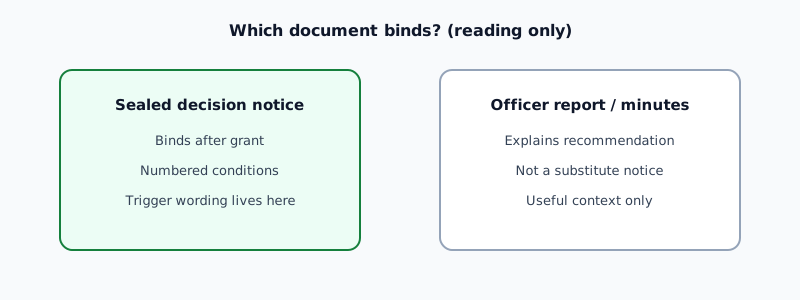
The notice binds
If permission is granted, the notice is the document that states the permission and the conditions. Build to the plans it lists. Discharge what its wording requires. Keep what it says you must keep. If it is later found to differ from the officer’s draft list, the sealed notice wins.
That is not a DecisionBrief slogan. The Secretary of State’s power to call in an application under section 77 of the Town and Country Planning Act 1990 can be exercised “at any time up to planning permission being issued” (GOV.UK, paragraph 024). A committee resolution is a decision of the authority. The permission is issued when the written notice goes out.
Most applications never reach committee. They are decided by an officer under a scheme of delegation (GOV.UK, paragraph 015, citing section 101 of the Local Government Act 1972). The same hierarchy applies: a delegated report, then a notice. The report still does not bind.
Once you have the issued notice, the next job is reading the trigger on each numbered condition — pre-commencement, during works, pre-occupation, or compliance-only, or start with the shorter pre-commencement vs pre-occupation page. That is a separate reading. It still starts from the notice, not from the report.
What the officer report is for
Read it. On many registers it is the only place the draft conditions appear in full before the notice is posted. It explains the recommendation, the policy balance, and why each condition is proposed. It is also where informatives live. DecisionBrief does not treat those notes as extra numbered conditions unless the notice itself numbers them.
It remains a recommendation. Members can adopt it, refuse against it, or amend the conditions. Officers can also change a draft list between the report and issue. Until you have the issued notice, you are reading a proposal.
What the minutes are for
Minutes tell you whether the recommendation survived. They record the vote, any recorded amendment, and sometimes what members were told in the room. If they say “approved as recommended”, that is a fact about the meeting. It is not a substitute for checking the issued wording.
If the minutes record an amendment, the notice should follow the amendment, not the original report. Do not programme the site from the unamended PDF you downloaded the week before committee.
When the three can part company
- Committee amends a condition the report had drafted.
- The sealed notice has not been issued yet, even though the vote is already on the minutes.
- The public register will not open the decision PDF — a captcha, a thin “approved” stamp with no schedule, or a file that will not load.
- Informatives on the report look like extra conditions. They are notes unless the notice numbers them.
- A later variation or appeal changes the notice. The old report does not update itself.
DecisionBrief’s job is to say which paper we could open, classify the conditions we can source, and stamp any gap. We do not invent a notice we have not seen.
Worked example · one live sample
York 25/01211/FUL — report and minutes, no sealed PDF
City of York Council 25/01211/FUL, 45 Hempland Lane: demolition of a bungalow and two apartment buildings containing eight flats. The officer report recommended approve, subject to the conditions numbered 1–22 in that report, plus the statutory biodiversity-gain plan under Schedule 7A flagged in informative 3. The minutes record that the committee approved. Vote: six in favour, three against. No amendment to the listed conditions is recorded — unlike Willow House later on the same agenda.
What we could not open: the sealed decision-notice PDF on City of York’s Idox public register. Simple search is reCAPTCHA-gated from the machine that wrote the sample. So the Hempland sample is sourced from the report the committee adopted and the minutes that record that adoption, not from the posted decision PDF. The sample says, in terms: if the sealed notice later differs, the sealed notice wins. The notice is not thin — twenty-two numbered conditions plus the statutory biodiversity-gain condition.
Two things sit on the minutes and not on the face of the condition list. Members were told that inherent Building Regulations still apply to the carbon condition, and that if the figures cannot be met the developer would need to write to officers. The agent told committee they did not know where the off-site biodiversity land would be. Those are facts on the minutes. They are not extra numbered conditions, and they are not advice about whether the biodiversity-gain plan will be discharged.
That is the point of the sample. A clean “approved as recommended” minute still leaves you one document short of the issued wording. Read the sourced sample, then decide whether you want the same reading for your own notice.
What a £79 DecisionBrief PDF is (and is not)
You paste the public URL of a named UK planning decision notice. We send a PDF in 24 hours that states the permission in plain English, lists every numbered condition we can source, classifies each as pre-commencement, during works, pre-occupation, or compliance-only, and cites the council wording so you can see the trigger. Neighbour personal names are redacted. If we can only open a report and minutes, the PDF says so. If the notice is thin, the PDF says so. If we cannot read a public decision, we refund. We do not invent conditions.
What it is not
- Not planning advice. We do not say whether the permission is implementable, lawful, or a good idea.
- Not discharge drafting. We do not write the WSI, LEMP, CEMP, biodiversity gain plan, or waste strategy.
- Not a search engine. You already have the notice; we read the one you send.
Order a £79 sourced reading See the York sample first
Related guides
- Thin or missing sealed decision notice — when the register PDF will not open or the notice is thin.
- How to read condition timing — four labels with York wording patterns.
- Informatives vs numbered conditions — unnumbered notes are not extra conditions.
Questions
Which document binds you?
The written decision notice issued to the applicant. GOV.UK says the local planning authority must notify the applicant using a written decision notice, and that the decision date on that notice is the date it is issued. The officer report recommends. The minutes record the resolution. If the sealed notice later differs from the report the committee adopted, the sealed notice wins.
What if I can open the officer report but not the decision notice?
Read the report as a recommendation and the minutes as the record of the vote. Do not treat either as the issued wording. On the York sample we could not open the sealed Idox PDF, so the brief is sourced from the report the committee adopted and the minutes that record that adoption — and it says so. See thin or missing sealed decision notice for event-led guidance. If we cannot read a public decision, we refund. We do not invent a notice we have not seen.
If committee approved as recommended, can I programme from the officer’s condition list?
The minutes tell you the recommendation survived the vote. They do not reprint the issued schedule. Until the written notice is issued, call-in can still be exercised, and the printed wording can still differ. DecisionBrief will cite the papers it could open and stamp the gap. That is a reading, not a green light to start.
What if committee amended the officer’s conditions?
The minutes should record the amendment. The notice should follow that amendment, not the original report. On the York sample, no amendment to the listed Hempland conditions is recorded; Willow House, later on the same agenda, is the contrast the minutes themselves draw. We follow what is published. We do not reconstruct an amendment we cannot source.
Is this planning advice?
No. This guide and the £79 PDF are sourced readings of public notices. The council’s decision notice remains the legal document. If you need advice, instruct a planning consultant or solicitor.
Will you write the discharge applications?
No. We classify the conditions and cite the wording. We do not prepare or lodge an application for approval of details reserved by condition.
Who runs DecisionBrief?
Ellis Greensitt, sole trader, trading as DecisionBrief. English law. See terms and privacy. Email hello@decisionbrief.co.uk. No telephone.
Sources cited on this page: GOV.UK — Determining a planning application (paragraphs 015, 019–021, 024); Town and Country Planning (Development Management Procedure) (England) Order 2015, article 35; Planning Portal — the decision-making process; Local Government Association / PAS — Best practice in officer report writing; DecisionBrief sample for City of York 25/01211/FUL, 45 Hempland Lane (committee report; minutes AI72609; agenda 7 May 2026). DecisionBrief is not City of York Council and is not the Planning Portal.