United Kingdom · guide · 9 September 2026
Informatives vs numbered conditions on UK planning decision notices
Applicants and developers often call everything after "Permission is granted" a "condition". Some of those lines are numbered conditions. Others are informatives — unnumbered notes, warnings, or reminders. The expensive mix-up is treating an informative as an extra condition you must discharge, or skipping a numbered condition because you thought it was only a note. This guide is reading literacy: how to tell which is which on the sealed notice.
This page is informational. It is not planning advice, not discharge-application writing, and not legal advice about whether an informative binds. Always read the sealed decision notice. Public sector information on samples is reused under the Open Government Licence v3.0.
What numbered conditions are
Numbered conditions are the lines the local planning authority lists under "Permission is granted subject to the following conditions…". Each condition is usually given a number (1, 2, 3…), a trigger statement, and a reason. GOV.UK guidance on use of planning conditions says conditions should be necessary, relevant to planning and to the development to be permitted, enforceable, precise, and reasonable in all other respects. The same guidance (paragraph 024) recommends ordering decision notices so that time limits and approved plans come first, then pre-commencement, then pre-occupancy or other stage conditions, then post-occupancy monitoring.
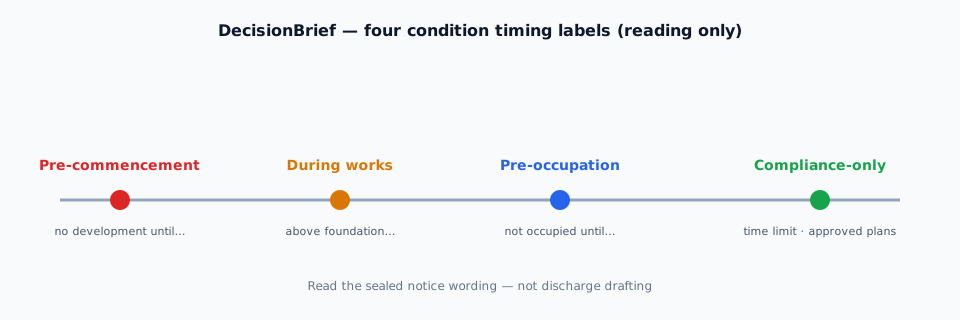
For applicants, numbered conditions are what you read for trigger and timing. DecisionBrief classifies each numbered line as pre-commencement, during works, pre-occupation, or compliance-only. See how to read condition timing for the full pattern set, or the shorter pre-commencement vs pre-occupation page.
What informatives are
Informatives (also called notes, advisories, or informative notes) are the unnumbered paragraphs that often follow the numbered conditions. They do not usually trigger a formal discharge application. Typical informatives remind you that:
- Building Regulations approval or building-control consent may be needed separately
- A highways consent, vehicle crossover, or separate licence is required for works in the public highway
- Protected species legislation (badgers, bats, birds) applies regardless of the planning grant
- A Section 106 planning obligation has been completed and binds the land
- The authority gave informal pre-application advice, or that the proposal aligns with a named policy
- The statutory biodiversity-gain plan under Schedule 7A of the Town and Country Planning Act 1990 must be approved before commencement — even though the notice did not number it as condition 23
Authorities have wide discretion in wording informatives. Some local planning authorities list them with numbers; others use bullets or plain paragraphs. Some label them "Informative 1, Informative 2…"; others say "Notes". The Planning Portal and GOV.UK do not mandate a particular format — the key distinction is whether the notice included the line in the numbered conditions schedule or separated it as a note.
The litmus test: what the sealed notice numbers
Read the sealed decision notice. Count the numbered lines in the conditions schedule. Stop at the last numbered line. Anything after that which is not numbered is an informative, unless the notice itself says "The following informatives are also conditions" (rare, and confusing if it happens). Do not promote an unnumbered note to condition 23 simply because the officer report listed it or because you think it sounds important.
| On the sealed notice | Is it a numbered condition? | What DecisionBrief does |
|---|---|---|
| "1. The development shall…" | Yes — numbered | Classify pre-comm / during / pre-occ / compliance |
| "22. Prior to occupation…" | Yes — numbered | Classify |
| "Informative: You are reminded that…" | No — unnumbered note | Do not invent a numbered condition from it |
| "Note 3: Building Regulations apply separately" | No — still a note | Do not count it |
| Report draft said "condition 23" but sealed notice has only 22 numbered lines | No — officer draft did not survive to issue | Follow the sealed notice |
Mix-ups applicants make most often
- Counting officer-report informatives as extra conditions. The York Hempland sample has 22 numbered conditions plus 12 informatives on the committee report. DecisionBrief does not treat informatives 1–12 as conditions 23–34. We count 22 numbered lines, plus the statutory biodiversity-gain plan flagged in informative 3 because the report itself says commencement is unlawful until it is approved.
- Ignoring a numbered condition because it "looks like a note". Time limits, approved-plans lists, and contamination contingencies are numbered conditions even though they do not always need a discharge. If the notice numbered it, DecisionBrief classifies it.
- Assuming numbered conditions end at 20 because informatives start at "Note 1". Some notices restart numbering for informatives. Read the schedule: if the last numbered condition says 22, conditions run 1–22; notes are separate.
- Treating an informative about Building Regulations as a planning discharge. Building control is not a planning condition discharge. Informatives that point to separate regimes (Regs, highways, protected species) are reminders, not extra planning submissions.
- Promoting statutory BNG from an informative when the report says it is mandatory. This is the hardest call. On York Hempland, informative 3 of the report flags the Schedule 7A biodiversity-gain plan and says commencement cannot lawfully proceed until it is approved. DecisionBrief treats that as an effective pre-commencement item because the statute and the report both say so, even though the notice did not reprint it as condition 23. Your notice may differ — we follow what is published and we note the reasoning.
What DecisionBrief does (and does not do)
The £79 PDF lists every numbered condition we can source from the sealed notice (or, where the notice will not open, from the report the committee adopted and the minutes that record that adoption). We classify each numbered line by trigger timing. We cite the council wording so you can see the trigger. We do not rewrite unnumbered informatives as extra numbered conditions.
If an informative points to a completed Section 106 planning obligation, we may note that reference if it appears on the paper we opened. See Section 106 vs conditions for how to spot obligation wording. If an informative flags the statutory biodiversity-gain plan and the report says commencement is unlawful without it, we record that reasoning. We do not invent conditions the notice did not number.
When might an informative still bind you?
This is a literacy guide, not legal advice. Some scenarios where informatives matter:
- Separate statutory regimes. Building Regulations, protected species law, and highways consents apply regardless of whether the planning notice numbers them. An informative about bats is a reminder that wildlife law exists; it is not optional.
- Planning obligations. If an informative says "This permission is subject to the planning obligation dated X", that is a pointer to a deed that binds the land. See S106 vs conditions.
- Statutory biodiversity net gain. Schedule 7A of the Town and Country Planning Act 1990 requires a biodiversity gain plan to be approved before commencement for relevant developments. Some authorities number it as a condition; others note it as an informative. The statute binds either way. DecisionBrief follows what the notice published and records any gap.
- Informal pre-app advice. An informative that says "The applicant was advised that…" is context. It does not create a new numbered condition, but it may be relevant if you later vary the permission or the authority alleges a breach.
If you need advice on whether a particular informative binds, instruct a planning consultant or solicitor. DecisionBrief stops at reading and classification.
What a £79 DecisionBrief PDF is (and is not)
You paste the public URL of a named UK planning decision notice. We send a PDF in 24 hours that states the permission in plain English, lists every numbered condition we can source, classifies each as pre-commencement, during works, pre-occupation, or compliance-only, and cites the council wording so you can see the trigger. Neighbour personal names are redacted. If the notice is thin or differs from the report, the PDF says so. If we cannot read a public decision, we refund. We do not invent numbered conditions from unnumbered notes.
What it is not
- Not planning advice. We do not say whether the permission is implementable, lawful, or a good idea.
- Not discharge drafting. We do not write the WSI, LEMP, CEMP, biodiversity gain plan, or waste strategy.
- Not legal advice on informatives. We do not advise on whether an unnumbered note binds or whether you need a separate consent.
- Not a search engine. You already have the notice; we read the one you send.
Order a £79 sourced reading See the York sample first
Related guides
- Decision notice vs officer report — which document binds.
- How to read condition timing — four labels with York wording patterns.
- Section 106 vs conditions — spotting obligation wording.
- Biodiversity net gain vs LEMP — when BNG sits in a note, not condition 23.
- Which conditions need a discharge application — submit-and-approve wording.
Questions
What is an informative on a planning decision notice?
An informative (sometimes called a note or advisory) is an unnumbered paragraph after the numbered conditions schedule. Informatives typically remind applicants of separate legislation (Building Regulations, highways consents, protected species), warn of informal advice the authority gave, or point to a planning obligation. Informatives are not numbered conditions unless the notice itself numbers them.
Should I treat informatives as extra numbered conditions?
No. DecisionBrief does not treat unnumbered notes as extra numbered conditions. We classify only what the sealed notice has numbered. If the sealed notice numbers what others call an informative, we count it; if it stays unnumbered, we do not invent a numbered condition from it.
What does DecisionBrief do if the notice numbers 22 conditions and has 12 informatives?
We classify the 22 numbered lines as pre-commencement, during works, pre-occupation, or compliance-only. The 12 informatives remain unnumbered notes. We do not rewrite note 3 as condition 23. If the paper you opened is thin or differs from the officer report, the PDF says so.
What about the statutory biodiversity net gain plan?
Schedule 7A of the Town and Country Planning Act 1990 requires a biodiversity gain plan for relevant developments. Some authorities number it as a condition; others flag it in an informative. On the York sample, informative 3 said commencement cannot lawfully proceed until the plan is approved, so DecisionBrief classified it with the pre-commencement set and recorded the reasoning. We follow what is published; if your notice differs, the brief will reflect that.
Is this planning advice?
No. This guide and the £79 PDF are sourced readings of public notices. The council's decision notice remains the legal document. If you need advice, instruct a planning consultant or solicitor.
Will you write the discharge applications?
No. We classify the conditions and cite the wording. We do not prepare or lodge an application for approval of details reserved by condition.
Who runs DecisionBrief?
Ellis Greensitt, sole trader, trading as DecisionBrief. English law. See terms and privacy. Email hello@decisionbrief.co.uk. No telephone.
Sources cited on this page: GOV.UK — Use of planning conditions (paragraphs 003, 024); Planning Portal — conditions and obligations; DecisionBrief sample for City of York 25/01211/FUL, 45 Hempland Lane (committee report; 22 numbered conditions plus 12 informatives, with statutory BNG in informative 3). Last reviewed 9 September 2026. DecisionBrief is not City of York Council and is not the Planning Portal.