United Kingdom · guide · 7 September 2026
Section 106 vs conditions on the decision notice — spotting the wording
Applicants often treat every requirement on a permission as “a condition”. Some of those lines are numbered conditions on the sealed notice. Others point to a separate Section 106 planning obligation. This guide is reading literacy only: how to spot which wording is which on the papers in front of you.
This page is informational. It is not planning advice, not legal advice on obligations, not negotiation of a deed, and not discharge-application writing. Always read the sealed decision notice and any sealed agreement the authority published. Public sector information cited below is reused under the Open Government Licence v3.0 where that licence applies.
Two tools, two places on the file
A local planning authority may grant permission subject to conditions, and it may also secure matters by a planning obligation under section 106 of the Town and Country Planning Act 1990 (often called an S106 agreement, or sometimes a unilateral undertaking). The Planning Portal separates those ideas: conditions appear on the decision; planning obligations are private agreements attached to make otherwise unacceptable development acceptable in planning terms, and they bind the land.
GOV.UK guidance on planning obligations (paragraph 003) says authorities should consider whether conditions or planning obligations can make development acceptable, and that planning obligations should only be used where it is not possible to address unacceptable impacts through a planning condition. That is policy guidance for authorities — not a reading of your notice.
For applicants, the practical literacy point is simpler: conditions are usually numbered on the face of the notice; an S106 is usually a separate deed the notice points to.
| Instrument | Typical home on the papers | What you are reading |
|---|---|---|
| Planning condition | Numbered schedule on the decision notice (“subject to the following conditions…”) | The trigger and duty printed on the grant |
| Section 106 / planning obligation | Recital on the notice, plus a separate agreement or unilateral undertaking on the register | Covenants, contributions, and triggers in the deed |
| Informative / note | Unnumbered notes after the conditions | Context — not a numbered condition unless the notice numbers it |
Condition wording cues on the sealed notice
Look for a clear schedule. Typical cues:
- “Permission is granted subject to the following conditions…”
- Numbered lines (1, 2, 3…) each with a reason
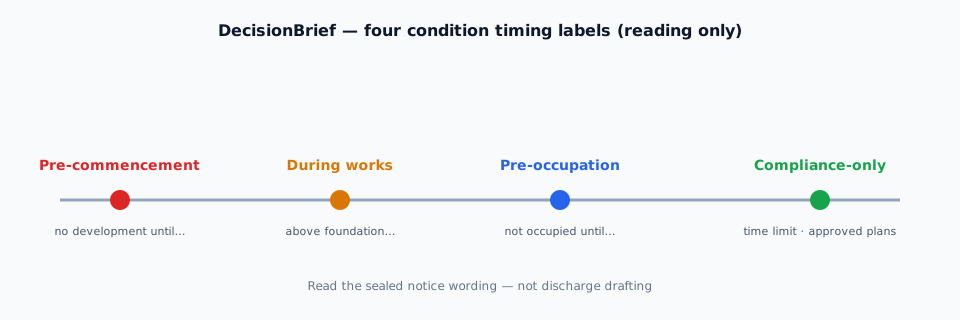
- Trigger phrases such as “No development shall take place until…”, “prior to occupation…”, “shall be carried out in accordance with the following plans…”
Those numbered lines are what DecisionBrief classifies as pre-commencement, during works, pre-occupation, or compliance-only. See how to read condition timing and the shorter pre-commencement vs pre-occupation page. Classification starts from the sealed notice, not from the officer report — see which document binds.
Section 106 wording cues on the same stack
An S106 is not usually rewritten as twenty numbered conditions. Spotting cues include:
- A grant or recital that permission is “subject to” a section 106 agreement, planning obligation, or unilateral undertaking (sometimes with a deed date)
- Wording that refers to “the planning obligation dated…”, “the agreement under section 106…”, or “the unilateral undertaking…”
- A separate PDF on the public register titled as a section 106 agreement, planning obligation, or UU — often with schedules for affordable housing, contributions, open space, or highways
- Officer-report or committee papers listing heads of terms for an obligation (useful context; not the sealed deed)
- An informative that points you to an agreement already completed, or that reminds you the land is bound by covenants outside the numbered conditions
GOV.UK describes planning obligations as legal obligations entered into to mitigate impacts — via an agreement under section 106 between a person with an interest in the land and the authority, or via a unilateral undertaking (planning obligations, paragraph 001). The Portal adds that the land itself is bound, so future owners take the obligation into account. Reading the notice means noticing when the grant points off-page to that deed.
Mix-ups applicants make most often
- Treating heads of terms as the deed. A committee report may list proposed affordable-housing or contribution terms. Until a sealed agreement exists (and the notice reflects that), you are reading a proposal.
- Treating an informative as a numbered condition. Notes after the schedule are not extra numbered conditions unless the notice numbers them.
- Assuming every payment or affordable-housing line is “condition 12”. Money and many affordable-housing covenants commonly sit in the obligation. Materials, CEMPs, and plan lists commonly sit in conditions. Always follow the paper in front of you.
- Confusing a Grampian-style condition with the deed itself. GOV.UK on the use of planning conditions discusses negatively worded conditions that limit development until a planning obligation has been entered into, and says that route is unlikely to be appropriate in most cases — completing the obligation before grant is preferred. If your notice uses that form, you are still reading a condition that points at an obligation; the covenants remain in the deed once completed.
- Programming from the report when the sealed notice is thin or missing. DecisionBrief’s York Hempland sample is the worked caution: report and minutes were open; the sealed Idox PDF was not. That sample records that no section 106 was seen on the papers opened. Say the gap; do not invent an agreement.
A short spotting checklist
-
Open the sealed decision notice (and any linked agreement PDF on the same register entry).
-
Mark the grant / recital for any “subject to section 106 / planning obligation / unilateral undertaking” language.
-
List the numbered conditions separately from any deed schedules. Quote the trigger on each numbered line.
-
Do not promote informatives or heads of terms into numbered conditions or into a deed you have not opened.
-
Stop at literacy. Spotting which paper says what is not the same as negotiating an obligation or lodging a discharge.
What a £79 DecisionBrief PDF is (and is not)
You paste the public URL of a named UK planning decision notice. We send a PDF in 24 hours that states the permission in plain English, lists every numbered condition we can source, classifies each as pre-commencement, during works, pre-occupation, or compliance-only, and cites the council wording so you can see the trigger. Neighbour personal names are redacted. If the notice refers to a planning obligation on the face of the paper we opened, we can note that reference. If the notice is thin, the PDF says so. If we cannot read a public decision, we refund. We do not invent conditions or invent a deed we have not seen.
What it is not
- Not planning or legal advice. We do not say whether the permission or any obligation is implementable, lawful, or a good idea.
- Not S106 drafting or negotiation. We do not prepare, vary, or discharge planning obligations.
- Not discharge drafting. We do not write the WSI, LEMP, CEMP, biodiversity gain plan, or waste strategy, and we do not lodge approval-of-details applications.
- Not a search engine. You already have the notice; we read the one you send.
Order a £79 sourced reading See the York sample first
Related guides
- Decision notice vs officer report — which document binds.
- How to read condition timing — four labels with York wording patterns.
- Pre-commencement vs pre-occupation — the two trigger labels mixed up most often.
- Informatives vs numbered conditions — how to tell unnumbered notes from numbered conditions.
Questions
Is a Section 106 the same as a planning condition?
No. Numbered conditions sit on the face of the decision notice as part of the grant. A Section 106 (planning obligation) is a separate legal agreement or unilateral undertaking under section 106 of the Town and Country Planning Act 1990. The notice may recite that permission is subject to an agreement; the detailed covenants usually live in that deed, not in the numbered condition schedule.
Where do I look first on the sealed notice?
Read the grant line and any recital that mentions a section 106, planning obligation, or unilateral undertaking. Then read the numbered conditions schedule. Then check informatives and the public register for a linked agreement PDF. Do not treat an officer-report heads-of-terms list as the sealed deed.
What if the notice is silent but the officer report mentioned an S106?
Treat the report as context. Programme and cite from the sealed notice and any sealed agreement you can open. If those papers do not show an obligation, say so — as the York sample does when no section 106 appears on the papers opened. DecisionBrief will not invent a deed from a report paragraph.
Will DecisionBrief negotiate or draft a Section 106?
No. The £79 PDF is a sourced reading of a named decision notice’s numbered conditions. We may note that the notice refers to an obligation if that wording is on the paper we opened. We do not draft, negotiate, vary, or discharge planning obligations.
Is this planning advice?
No. This guide and the £79 PDF are sourced readings of public notices. The council’s decision notice and any sealed planning obligation remain the legal documents. If you need advice, instruct a planning consultant or solicitor.
Will you write the discharge applications?
No. We classify the conditions and cite the wording. We do not prepare or lodge an application for approval of details reserved by condition.
Who runs DecisionBrief?
Ellis Greensitt, sole trader, trading as DecisionBrief. English law. See terms and privacy. Email hello@decisionbrief.co.uk. No telephone.
Sources cited on this page: Planning Portal — conditions and obligations; GOV.UK — Planning obligations (paragraphs 001, 003); GOV.UK — Use of planning conditions; DecisionBrief sample for City of York 25/01211/FUL, 45 Hempland Lane (no section 106 seen on the papers opened). Last reviewed 7 September 2026. DecisionBrief is not City of York Council and is not the Planning Portal.