United Kingdom · planning decision notices · reading only
Pre-commencement vs pre-occupation — reading the trigger line only
Two common condition trigger labels on UK planning decision notices — what the sealed wording usually signals, how they differ from “during works”, and why the officer report is not enough on its own. Not planning advice.
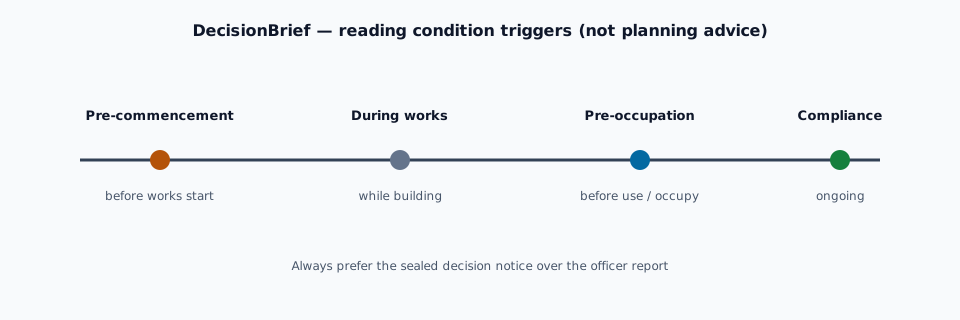
Many UK decision notices use trigger wording that tells you when a numbered condition bites — before works start, while works are underway, before occupation, or as ongoing compliance. This page focuses on two labels applicants and agents mix up most often: pre-commencement and pre-occupation. For the fuller four-label map, see how to read planning decision-notice conditions.
Read the sealed notice first
The written decision notice is the document that binds after a grant. The officer report and committee minutes may explain reasoning, but they are not a substitute for the sealed notice. See decision notice vs officer report vs minutes.
If you cannot open the sealed PDF, say so plainly — do not invent condition text from the report alone. DecisionBrief refuses to invent conditions; if the public notice is thin, the PDF says so.
Public-sector context for why timing labels matter: the Planning Portal summarises familiar groups (details before implementation, restrictions during works, restrictions on use once complete). GOV.UK guidance on the use of planning conditions (paragraph 024) also recommends ordering notices so time limits and approved plans come first, then pre-commencement, then pre-occupancy or other stage conditions. That is policy guidance for authorities — not a reading of your notice.
Worked example · one live sample
York 25/01211/FUL — Hempland Lane
See how DecisionBrief classifies numbered conditions with trigger labels and cites the council wording — not discharge drafting.
Pre-commencement (reading only)
Wording that requires something to be submitted, approved, or done before development starts (or before a defined start of works) is typically labelled pre-commencement in DecisionBrief’s reading. Exact phrasing varies by authority. Always quote the numbered condition on the notice.
Typical triggers to look for on the sealed page:
- “No development shall take place until…”
- “Prior to the commencement of the development…” / “prior to the commencement of works…”
- Archaeology wording that bars evaluation and development until a written scheme of investigation is approved
- CEMP / LEMP / biodiversity / construction-method packages that stop any start until written approval
GOV.UK (paragraph 007) flags “no development shall take place until…” and “prior to any works starting on site…” as classic pre-commencement forms — and says such conditions should only be used where the timing is fundamental. That is not clearance for your site; it is a reading cue.
Pre-occupation (reading only)
Wording that requires something before the building is occupied or brought into use is typically labelled pre-occupation. It is not the same trigger as pre-commencement: works may already be underway while a pre-occupation item is still open.
Typical triggers:
- “Shall not be occupied until…”
- “Prior to occupation…”
- “Prior to the development coming into use…” / “no part of the site shall come into use until…”
Highway, parking, visibility, refuse, and similar conditions often sit here. Several use “coming into use” rather than “occupied”; DecisionBrief still labels them pre-occupation because the barrier is use, not start on site. Some pre-occupation items need physical works on site (parking laid out); others need a written strategy. Classification is not the same as drafting a discharge pack.
Do not confuse with “during works”
“Prior to construction above foundation level”, “within three months of commencement”, or “prior to the installation of any new external lighting” is not pre-commencement under DecisionBrief’s labels if the wording already allows demolition or foundations. We call that during works — a later-stage approval, not a “no development until” stop.
The Planning Portal’s plain-language note often groups materials approval under pre-commencement. DecisionBrief does not. If the council’s own sentence allows work before that approval, we refuse to pretend it is a “no development until” condition. Worked patterns from a live York sample are on the sibling guide and the Hempland sample.
A short reading checklist
-
Open the sealed decision notice (not only the officer report). Note the application reference and date.
-
For each numbered condition, quote the trigger clause — the words that say when it bites.
-
Label the trigger as pre-commencement, during works, pre-occupation, or compliance-only — using the council wording, not hope.
-
Do not invent discharges. Classification is not the same as writing or lodging an approval-of-details application.
What a £79 DecisionBrief PDF is (and is not)
You paste the public URL of a named UK planning decision notice. We send a PDF in 24 hours that states the permission in plain English, lists every numbered condition we can source, classifies each with DecisionBrief’s timing labels, and cites the council wording so you can see the trigger. Neighbour personal names are redacted. If the notice is thin, the PDF says so. If we cannot read a public decision, we refund. We do not invent conditions.
What it is not
- Not planning advice. We do not say whether the permission is implementable, lawful, or a good idea.
- Not discharge drafting. We do not write the WSI, LEMP, CEMP, biodiversity gain plan, or waste strategy.
- Not a search engine. You already have the notice; we read the one you send.
Order a £79 sourced reading See the York sample first
Questions
Is pre-occupation the same as pre-commencement?
No. Pre-commencement wording typically stops development or works until something is submitted and approved. Pre-occupation wording typically stops occupation or “coming into use” until something is done. Works may already be underway while a pre-occupation item is still open. Always quote the numbered condition on the sealed notice.
Is “prior to construction above foundation” a pre-commencement condition?
Not under DecisionBrief’s labels. If the wording allows demolition or foundations before approval, we call it during works. True pre-commencement wording stops development or works until written approval is in place. See the sibling conditions guide and the York materials example.
Do I need to discharge every condition?
No. Only conditions that require details to be submitted and approved in writing typically need a formal approval-of-details application. Compliance-only conditions describe a duty to do or keep something. Pre-occupation wording may require physical works, a written strategy, or both. DecisionBrief classifies the trigger; it does not write or lodge discharges.
Is this planning advice?
No. This guide and the £79 PDF are sourced readings of public notices. The council’s decision notice remains the legal document. If you need advice, instruct a planning consultant or solicitor.
Will you write the discharge applications?
No. We classify the conditions and cite the wording. We do not prepare or lodge an application for approval of details reserved by condition.
Who runs DecisionBrief?
Ellis Greensitt, sole trader, trading as DecisionBrief. English law. See terms and privacy. Email hello@decisionbrief.co.uk. No telephone.
Informational reading guide only. Sources: Planning Portal — conditions and obligations; GOV.UK — Use of planning conditions. Last reviewed Sep 2026. DecisionBrief is not City of York Council and is not the Planning Portal.