United Kingdom · guide · 14 September 2026
Biodiversity net gain vs LEMP conditions on decision notices
Modern UK permissions often carry several ecology-related lines: statutory biodiversity net gain under Schedule 7A, a landscape and ecological management plan (LEMP), and sometimes a separate biodiversity enhancement plan. The expensive mix-up is treating them as one document — or missing the statutory BNG line because it appeared as an informative rather than condition 23. This guide is reading literacy: BNG vs LEMP on the sealed notice, not ecology or BNG plan drafting.
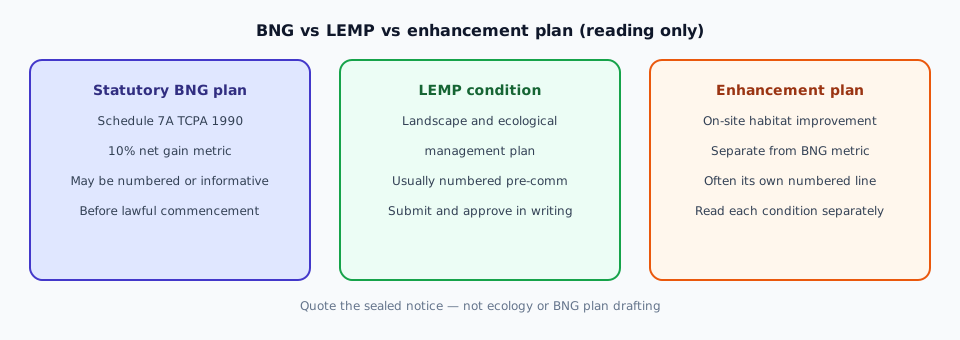
Three different lines — read each separately
When applicants search for biodiversity net gain planning condition wording, they often find more than one ecology line on the same notice. DecisionBrief reads them as separate items with separate triggers:
- Statutory biodiversity net gain (BNG) — Schedule 7A of the Town and Country Planning Act 1990 requires a biodiversity gain plan to be approved before lawful commencement for relevant developments. The 10% net gain metric is a statutory regime, not a generic landscaping condition.
- LEMP — “Landscape and ecological management plan” (or similar) is usually its own numbered condition: details submitted and approved in writing, often pre-commencement, covering long-term management of planting, habitats, and monitoring after completion.
- Biodiversity enhancement plan — Often a separate numbered line about on-site habitat creation or improvement proposed with the application. It is not the same document as the statutory BNG plan, even when both mention “biodiversity”.
BNG vs LEMP is therefore a reading task: quote each numbered line (or statutory informative) on its own wording. Do not assume one ecologist’s pack satisfies every line.
Where biodiversity net gain appears on the notice
Authorities differ in how they print statutory BNG:
- Numbered condition — “No development shall commence until the biodiversity gain plan required by Schedule 7A… has been submitted to and approved in writing…”
- Informative — An unnumbered note after the conditions schedule flags Schedule 7A and states commencement is unlawful until the plan is approved — even though the notice did not reprint it as the next condition number.
- Both — Some notices number a LEMP or enhancement plan while the statutory BNG plan sits in an informative. See informatives vs numbered conditions.
On the York Hempland sample, informative 3 of the committee report flags the statutory biodiversity-gain plan and says development cannot lawfully commence until it is approved. DecisionBrief classified it with the pre-commencement set and recorded the reasoning — separate from the numbered LEMP and enhancement plan conditions in the same permission. Your notice may differ; we follow what is published.
| Label on notice | Typical purpose (reading only) | Common trigger |
|---|---|---|
| Biodiversity gain plan / Schedule 7A / BNG | Statutory 10% net gain metric approval | Before lawful commencement |
| LEMP / landscape and ecological management plan | Long-term landscape and ecology management details | Often pre-commencement submit and approve |
| Biodiversity enhancement plan | On-site habitat improvement reserved by condition | Usually its own numbered pre-comm line |
| Informative about BNG only | Statutory reminder — may still block commencement | Read whether report/notice says unlawful to start |
Typical LEMP condition wording
LEMP conditions on decision notices often follow reserved-details patterns:
- “Details of a landscape and ecological management plan (LEMP) shall be submitted to and approved in writing by the local planning authority prior to the commencement of development…”
- “No development shall commence until the LEMP… has been approved in writing…”
- Reason lines may cite landscape character, protected species, or policy — DecisionBrief cites the reason but does not advise on ecology.
A LEMP condition is about management details reserved by the permission. The statutory BNG plan is about the metric regime under Schedule 7A. Both may need written approval before you start; they are still separate reading lines. See which conditions need a discharge application for submit-and-approve wording patterns.
Mix-ups to avoid
- Submitting one ecology pack for every line. The LEMP, enhancement plan, and BNG plan may each need their own approval step if the notice says so.
- Ignoring BNG because it is an informative. Schedule 7A binds whether or not the authority numbered it. See informatives vs numbered conditions.
- Treating “biodiversity” in the title as interchangeable. “Biodiversity enhancement plan” and “biodiversity gain plan” are different phrases on the notice — read the full condition text.
- Using the officer report plan list instead of the notice. The sealed notice wins. See decision notice vs officer report.
What DecisionBrief does (and does not do)
On the £79 sourced PDF we quote each ecology-related numbered line we can source, classify the trigger (pre-commencement, during works, pre-occupation, or compliance-only), and cite the page. If statutory BNG appears only in an informative and the adopted report says commencement is unlawful without approval, we record that reasoning — as on the York sample.
What it is not
- Not ecology or BNG plan drafting. We do not write LEMPs, biodiversity gain plans, or enhancement plans.
- Not discharge drafting. We do not prepare or lodge approval-of-details applications.
- Not planning advice. We do not say whether your metric, habitat, or management approach is acceptable to the authority.
£79 one-off · one named notice · PDF in 24 hours
Order a £79 sourced reading See the York sample first
Related guides
- Informatives vs numbered conditions — when BNG sits in a note, not condition 23.
- Which conditions need a discharge application — submit-and-approve wording.
- How to read condition timing — pre-commencement labels for LEMP lines.
- Pre-commencement vs pre-occupation — read the trigger line only.
Questions
What is a biodiversity net gain planning condition?
On decision notices, biodiversity net gain may appear as a numbered condition requiring a biodiversity gain plan under Schedule 7A, or as an informative noting that commencement is unlawful until that statutory plan is approved. DecisionBrief quotes what the sealed notice or adopted report states — we do not draft BNG plans.
What is the difference between BNG and LEMP?
Statutory BNG is the 10% net gain metric regime under Schedule 7A. A LEMP is typically a separate numbered condition for long-term landscape and ecology management details. A biodiversity enhancement plan is often yet another line about on-site habitat improvement. Read each condition separately.
Can one permission have BNG, LEMP, and enhancement plan conditions?
Yes. DecisionBrief lists and classifies each numbered line we can source. We do not write ecology or BNG plan documents.
Will DecisionBrief write the LEMP or biodiversity gain plan?
No. We classify conditions and cite council wording. We do not prepare LEMPs, biodiversity gain plans, or lodge discharge applications.
Is this planning advice?
No. This guide and the £79 PDF are sourced readings of public notices. If you need ecology or planning advice, instruct a suitably qualified consultant or solicitor.
Sources cited on this page: Schedule 7A Town and Country Planning Act 1990 (biodiversity net gain); GOV.UK — Use of planning conditions; DecisionBrief sample for City of York 25/01211/FUL, 45 Hempland Lane (LEMP, enhancement plan, and statutory BNG in informative 3). Last reviewed 14 September 2026. DecisionBrief is not a local planning authority.