United Kingdom · planning decision notices · reading only
Approved plans conditions — binding drawings vs officer-report schedules
Many UK planning permissions include a condition that development must be carried out in accordance with approved plans or drawings. This guide explains how to read that wording on the sealed decision notice — and why the drawing list on the officer report is not always the binding schedule.
What “approved plans” conditions usually say
Typical patterns on decision notices include:
- “The development hereby permitted shall be carried out in accordance with approved plans/drawings [list or schedule reference].”
- “Development as shown on drawing nos. … dated …”
- “In accordance with the plans and drawings listed in the schedule attached to this notice.”
The condition names which drawings bind. If the schedule is missing, illegible, or points at the wrong revision, that is a reading problem on the notice itself — not something to guess from committee slides.
Worked example · one live sample
York 25/01211/FUL — Hempland Lane
See how DecisionBrief classifies numbered conditions with trigger labels and cites the council wording — not discharge drafting.
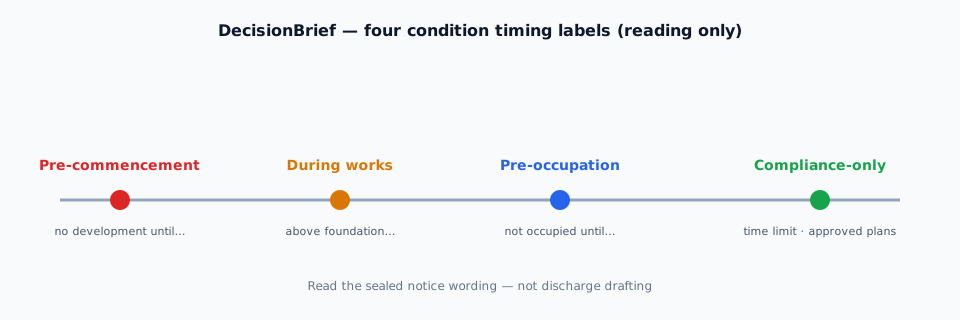
What binds: the sealed notice
As with any other condition topic, the sealed decision notice is the document that states the permission and the numbered conditions. If the notice lists drawing A-100 Rev P02 and drawing L-200 Rev P01, those are the references you quote when you read the permission back.
The officer report may recommend approval subject to plans “as shown in the report at appendix X”. That appendix is useful context. It does not replace the notice schedule if the sealed notice lists different numbers or revisions. See decision notice vs officer report for the wider rule: the sealed notice wins.
Drawing references to check
-
Drawing number — e.g. A-100, GA-01, SK-200. Copy exactly as printed.
-
Revision or date — “Rev P02”, “Issue 3”, “dated 14 March 2026”. A stale revision on site is a common compliance risk.
-
Title or description — “Proposed ground floor plan”, “Elevations”. Helps match PDFs on the planning register.
-
Whether the schedule is on the notice or annexed — some councils attach a drawing schedule sheet; others inline three drawing numbers in the condition text.
Compliance-only vs details reserved
Many “approved plans” conditions are compliance-only: build exactly what those drawings show. No separate submission step is described on the face of the condition — you still have a legal duty to match the approved set.
Other conditions reserve details (“details of landscaping to be submitted”, “material samples to be approved”). Those may need a written approval step before you implement that element. DecisionBrief classifies the trigger wording; we do not draft or lodge discharge applications. See how to read condition timing and which conditions need a discharge application.
When the notice and the register disagree
Planning registers sometimes host multiple PDF revisions. If the notice cites Rev P02 but the register only shows Rev P01, note the gap and ask the local planning authority which file is approved — DecisionBrief records what the named notice states, not what you assume was intended.
What DecisionBrief does with approved-plans wording
On the £79 sourced PDF we quote the approved-plans condition, list drawing references exactly as printed, classify the trigger (compliance-only vs details reserved where the wording allows), and cite the page. We do not redraw plans, negotiate revisions, or write discharge packs.
Order a £79 sourced reading All guides
Questions
Do officer-report drawing lists bind if they are not on the notice?
Usually the sealed decision notice controls. If the notice schedule lists specific drawing numbers and revisions, quote those. Officer-report appendices are context, not a substitute for the notice schedule unless the notice explicitly incorporates them.
Is an approved-plans condition always compliance-only?
Often yes — “build in accordance with approved plans” describes a duty to match the listed drawings. Some permissions mix approved-plans wording with separate conditions that reserve further details. Read each numbered line on its own wording.
Will DecisionBrief write discharge applications for reserved details?
No. We classify conditions and cite council wording. We do not prepare, lodge, or chase an application for approval of details reserved by condition.
Is this planning advice?
No. This guide and the £79 PDF are sourced readings of public notices. Instruct a planning consultant or solicitor if you need advice.
Informational reading guide only. Sources: GOV.UK — use of planning conditions. Last reviewed 10 September 2026. DecisionBrief is not a local planning authority.