United Kingdom · guide · 22 September 2026
Noise, hours of operation, and delivery restrictions on UK planning decision notices
Construction noise, hours of working, and delivery curfews rarely appear as a single line labelled "noise condition". They sit inside Construction Environmental Management Plans (CEMPs), construction traffic management plans, method-of-works statements, and sometimes unnumbered NOTEs after a numbered condition. The expensive mix-up is assuming site hours are advisory because they look like a footnote, or treating a CEMP as compliance-only when the notice says no commencement until it is approved. This guide is reading literacy: how to find and classify noise-related wording on the sealed notice.
This page is informational. It is not planning advice, not discharge-application writing, and not acoustic consultancy. Always read the sealed decision notice. Public sector information on samples is reused under the Open Government Licence v3.0.
Three places noise and hours wording hides
On UK decision notices, noise, vibration, dust, hours of working, and delivery restrictions typically appear in one of three places:
- A numbered CEMP or environmental management condition — requires a plan covering noise, vibration, and dust to be submitted and approved before commencement, then implemented during works.
- A numbered construction traffic or method-of-works condition — requires a statement or CTMP approved before works start, listing routing, signing, mud prevention, contractor parking, material storage, and often hours of working including hours when visiting vehicles are prohibited.
- An unnumbered NOTE or informative — sometimes printed immediately after a numbered condition, setting out specific weekday hours, Saturday hours, complaint procedures, or delivery curfews without re-numbering them as a separate condition.
Some permissions also carry compliance-only use restrictions ("the use shall not operate outside…") for operational noise after build-out. Those are occupation-phase limits, not construction CEMPs. Read each numbered line separately; do not collapse them into one "noise package".
CEMP conditions: pre-commencement, then operational
A typical CEMP condition says that prior to commencement, a Construction Environmental Management Plan for minimising noise, vibration, and dust during demolition, site preparation, and construction shall be submitted to and approved in writing, and that all works shall be carried out in accordance with the approved scheme. That wording is classic pre-commencement: you need written approval before lawful start, including demolition where the condition says so explicitly.
On the York Hempland sample, condition 12 follows that pattern. The officer report then prints a long NOTE after condition 12 listing weekday hours (08:00–18:00 Monday–Friday, 08:00–13:00 Saturday), vibration and dust controls, lighting limits, a complaints procedure, and monthly forwarding of complaints to named council mailboxes. That NOTE sits on the source PDF; DecisionBrief does not promote it to an extra numbered condition, but we record that it appears on the paper we opened. See informatives vs numbered conditions for the numbering rule.
GOV.UK guidance on use of planning conditions (paragraph 024) recommends ordering notices so pre-commencement items come before later-stage conditions. CEMPs often appear early in the schedule for that reason. The guidance is for authorities drafting notices; your job as reader is to spot the trigger in the council's own sentence.
Hours of working and delivery restrictions in CTMP / method-of-works conditions
Construction traffic management plans and method-of-works statements are another common home for hours and delivery rules. A numbered condition may require a detailed statement approved prior to development commencing, listing routing, signing, mud prevention, contractor parking, material storage — and hours of working (including hours where vehicles visiting the site will be prohibited), sometimes with a named local context such as nearby schools.
On Hempland, condition 14 is pre-commencement and expressly includes site clearance. The hours limb is not a freestanding condition 14(a) on the sealed notice; it is content that must appear inside the approved statement. Once the authority approves the CTMP, contractors work to those hours. Changing them later usually needs written agreement with the local planning authority, not an informal site decision.
Delivery restrictions follow the same logic. If the notice says vehicles shall not visit outside approved hours, or prohibits deliveries on Sundays, that rule may live inside the approved plan rather than as a separate numbered line. DecisionBrief classifies the numbered parent condition and cites where hours appear — in the condition text, in an attached NOTE, or only in the officer report if the sealed notice is thin. See thin or missing sealed decision notice if the register PDF will not open.
| Wording on the notice | Typical label | What to read next |
|---|---|---|
| "Prior to commencement… CEMP… approved in writing" | Pre-commencement | Discharge the CEMP; then implement during works |
| "Hours of working… in the approved method-of-works statement" | Pre-commencement (parent condition) | Hours bind via the approved CTMP, not a separate number |
| NOTE after condition 12 listing 08:00–18:00 weekdays | Unnumbered note (unless notice numbers it) | Follow informatives guide; do not invent condition 23 |
| "Prior to the installation of any new external lighting…" | During works | Lighting spill affects neighbours and ecology — separate from CEMP hours |
| "The use shall not operate between 22:00 and 07:00" | Often compliance-only or pre-occupation | Operational limit after build — not a construction CEMP |
Mix-ups applicants make most often
- Treating NOTE hours as informal because they follow the numbered condition. On some notices the NOTE is part of the adopted wording. On others it is genuinely unnumbered. Read the sealed notice and compare it to the officer report with decision notice vs officer report.
- Assuming demolition can start before the CEMP is approved. Many CEMP conditions cover demolition explicitly. "Prior to commencement of the development" often includes demolition even when your programme treats them separately.
- Ignoring delivery curfews because they sit inside a CTMP bullet list. If the numbered condition requires the approved plan to prohibit vehicle visits outside stated hours, those hours bind through the approved document.
- Confusing CEMP noise controls with operational use restrictions. A restaurant or logistics condition limiting operating hours is a different trigger from a construction CEMP. Classify each numbered line with how to read condition timing.
- Expecting one discharge to cover CEMP and CTMP. They are often separate numbered conditions with separate approval steps. DecisionBrief lists each numbered line we can source; we do not merge them in the PDF.
What DecisionBrief does (and does not do)
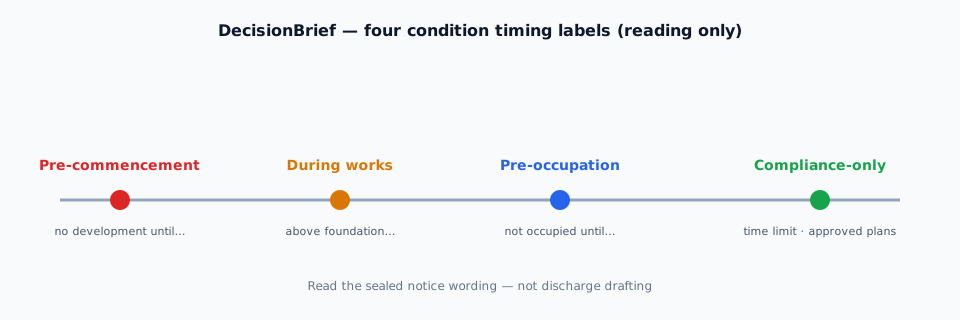
The £79 PDF lists every numbered condition we can source from the sealed notice (or, where the notice will not open, from the report the committee adopted). We classify each line as pre-commencement, during works, pre-occupation, or compliance-only, and cite the council wording so you can see whether hours bind through a CEMP, a CTMP, or an unnumbered NOTE. We do not rewrite NOTE text as extra numbered conditions.
If a condition requires approval in writing before commencement, see which conditions need a discharge application for the submit-and-approve pattern. We classify; we do not prepare CEMPs, acoustic assessments, or CTMPs.
What a £79 DecisionBrief PDF is (and is not)
You paste the public URL of a named UK planning decision notice. We send a PDF in 24 hours that states the permission in plain English, lists every numbered condition we can source, classifies each by trigger timing, and cites the council wording. Neighbour personal names are redacted. If the notice is thin or differs from the report, the PDF says so. If we cannot read a public decision, we refund.
What it is not
- Not planning advice. We do not say whether your programme complies with hours or whether to challenge a condition.
- Not discharge drafting. We do not write the CEMP, CTMP, method-of-works statement, or acoustic assessment.
- Not environmental health advice. We do not interpret BS 5228, Section 61 agreements, or environmental permit regimes.
- Not a search engine. You already have the notice; we read the one you send.
Order a £79 sourced reading See the York sample first
Related guides
- How to read condition timing — four labels with York wording patterns.
- Informatives vs numbered conditions — when NOTE hours are not condition 23.
- Which conditions need a discharge application — submit-and-approve wording.
- Pre-commencement vs pre-occupation — when operational hours differ from construction limits.
- Delegated vs committee wording — confirming which paper adopted the CEMP wording.
Questions
Where do hours of working usually appear on a planning decision notice?
Hours of working may sit in a numbered condition (often a CEMP or construction traffic / method-of-works condition), in a NOTE or informative printed after that condition, or in both. On the York Hempland sample, condition 14 required hours of working in the approved method-of-works statement, while condition 12's CEMP NOTE listed specific weekday and Saturday hours. Read the sealed notice to see whether hours bind as numbered condition text or as an unnumbered note.
Is a CEMP a noise condition or a pre-commencement discharge?
Usually both. A typical CEMP condition requires a plan covering noise, vibration, and dust to be submitted and approved in writing prior to commencement. That makes it pre-commencement for discharge purposes. Once approved, the CEMP becomes the operational document contractors follow during demolition and construction. DecisionBrief classifies the numbered trigger; we do not write CEMPs.
Do delivery time restrictions need a separate discharge application?
Often they are embedded in a construction traffic management plan or method-of-works condition that must be approved before works start. If the notice says hours where visiting vehicles are prohibited must be shown in the approved plan, you discharge the parent condition once — the hours then live inside the approved document. If hours appear only in an unnumbered informative, they may still matter for enforcement context but are not an extra numbered condition unless the notice numbers them.
What if the sealed notice is shorter than the officer report?
Follow the sealed notice first. If the register PDF omits NOTE hours that appear on the committee report, the PDF says so. See thin or missing sealed decision notice and decision notice vs officer report.
Is this planning advice?
No. This guide and the £79 PDF are sourced readings of public notices. The council's decision notice remains the legal document. If you need acoustic or planning advice, instruct a suitably qualified consultant or solicitor.
Will you write the CEMP or CTMP?
No. We classify the conditions and cite the wording. We do not prepare or lodge discharge applications or construction management plans.
Who runs DecisionBrief?
Ellis Greensitt, sole trader, trading as DecisionBrief. English law. See terms and privacy. Email hello@decisionbrief.co.uk. No telephone.
Sources cited on this page: GOV.UK — Use of planning conditions (paragraph 024); Planning Portal — conditions and obligations; DecisionBrief sample for City of York 25/01211/FUL, 45 Hempland Lane (condition 12 CEMP with NOTE hours; condition 14 method-of-works / CTMP with hours limb). Last reviewed 22 September 2026. DecisionBrief is not City of York Council and is not the Planning Portal.