United Kingdom · planning decision notices · reading only
Delegated vs committee wording on planning notices
How to read whether a UK planning decision notice states delegated or committee approval — typical wording patterns on published notices, not advice on which route was correct or whether to challenge. Informational only.
What the notice usually states
Most UK local planning authorities print a decision line near the top of the notice that names the decision-maker: "decided at Planning Committee on [date]" or "decided under delegated powers" are common forms. The wording varies by council.
If the notice is silent or ambiguous, say so — do not invent the route from a neighbour comment or the fact that the application was large. DecisionBrief refuses to invent decision facts if the published notice does not state them.
Worked example · one live sample
York 25/01211/FUL — Hempland Lane
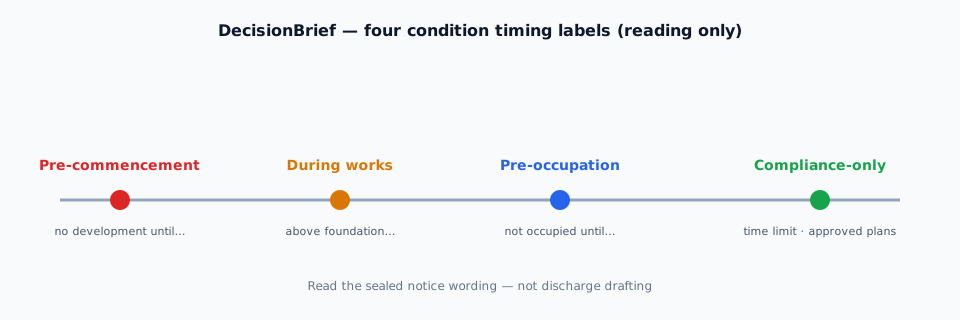
See how DecisionBrief classifies numbered conditions with trigger labels and cites the council wording — not discharge drafting.
Delegated decision wording
Typical patterns on notices where an officer decided under delegated authority:
- "This application has been determined under delegated powers."
- "Decided by [Officer Title] under the Scheme of Delegation."
- "Delegated decision — [date] — [Officer name/title]."
- "Decision made under delegated authority on behalf of the Council."
Some councils name the delegated officer; others state only that delegation was used. Either form is a delegated decision if the text says so.
Committee decision wording
Typical patterns on notices where the planning committee decided:
- "Decided at Planning Committee on [date]."
- "Planning Committee — [date] — Approved."
- "This permission was granted by the Planning Committee on [date]."
- "Committee decision: [date]."
The officer report and minutes may add context, but the sealed decision notice remains the binding document. If the notice prints "Committee", that is what you quote when you read the decision route back.
Why the route matters to applicants
Knowing the decision route may be relevant for understanding local policy, timescales, or whether the decision was called in from delegation. It does not change the legal effect of the permission or the wording of the numbered conditions. A grant is a grant; a refusal is a refusal — whichever route was used.
If you think the wrong route was followed, DecisionBrief cannot advise whether to challenge. Instruct a planning consultant or solicitor.
When the notice is silent
Occasionally a published notice states the date but omits whether the decision was delegated or committee. If the route is not printed, DecisionBrief records that omission rather than guessing from application size, neighbour objection count, or officer-report recommendation. The published register or council may clarify; if not, note it and move on.
Public-interest wording patterns
For context, GOV.UK guidance on planning enforcement and the Local Government Association's committee guidance describe delegation frameworks and when applications are called to committee, but those are not readings of your individual notice. Always cite the sealed decision document first.
What DecisionBrief does with decision-route wording
On the £79 PDF, we quote the decision line from the notice if it is present — "Delegated" or "Committee [date]" or "Not stated on this notice" — and cite the page reference. We do not invent the route and we do not advise whether the route was correct. That is a plain reading, not legal or planning advice.
Order a £79 sourced reading All guides
Questions
Does delegated mean the decision is weaker than committee?
No. A delegated grant is a valid planning permission; a committee grant is a valid planning permission. Both bind the local planning authority. The decision route does not change the legal effect of the permission or the numbered conditions. If you think the wrong route was used, instruct a planning consultant or solicitor.
Can I challenge a decision because it was delegated when it should have gone to committee?
DecisionBrief does not advise on challenge routes or merits. Instruct a planning consultant or solicitor if you want to explore whether grounds exist.
Is this planning advice?
No. This guide and the £79 PDF are sourced readings of public notices. The council's decision notice remains the legal document. If you need advice, instruct a planning consultant or solicitor.
Who runs DecisionBrief?
Ellis Greensitt, sole trader, trading as DecisionBrief. English law. See terms and privacy. Email hello@decisionbrief.co.uk. No telephone.
Informational reading guide only. Sources: GOV.UK — ensuring effective enforcement; LGA — planning committees. Last reviewed 8 September 2026. DecisionBrief is not a local planning authority.