United Kingdom · planning decision notices · reading only
Reserved matters conditions on outline permission — reading the notice only
Outline planning permission grants permission in principle — but the decision notice usually lists which matters remain reserved (scale, layout, appearance, access, landscaping) and imposes conditions that bind the later reserved-matters application. This guide helps you read that wording on the sealed notice. Not planning advice.
Outline permission is a two-stage route: first the outline decision notice, then one or more reserved-matters approvals. The outline notice is not a blank cheque — its numbered conditions typically include time limits, parameters (maximum dwellings, height bands), and constraints that the reserved-matters application must respect. Reading literacy starts with the sealed outline notice, not the officer report alone.
Read the sealed notice first
The written decision notice is the document that binds after a grant. See decision notice vs officer report vs minutes. If you cannot open the sealed PDF, say so plainly — do not invent condition text from the report alone.
The Planning Portal explains that outline applications seek approval of a principle, with details reserved for a later stage. GOV.UK guidance on outline and reserved-matters applications describes the standard matters that may be reserved. That is public context — not a reading of your notice.
Worked example · one live sample
York 25/01211/FUL — Hempland Lane
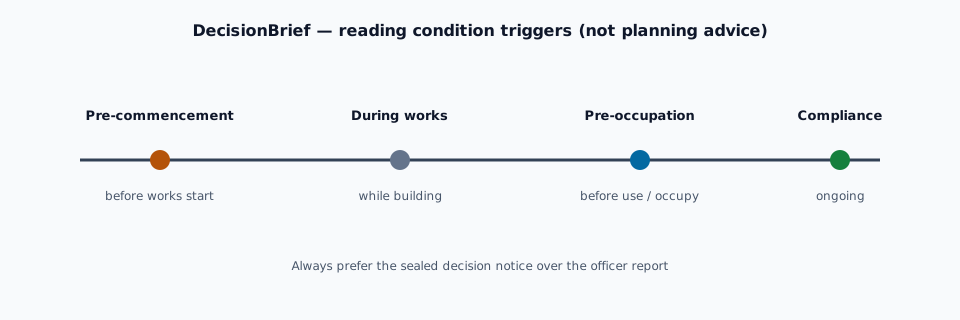
The York sample is a full permission (not outline) — but it shows how DecisionBrief classifies numbered conditions, time limits, and trigger labels on a sealed notice. Use it as a reading habit reference.
What “reserved matters” means on the notice
On an outline decision notice, the permission paragraph usually states which matters are reserved for later approval. Common reserved matters under the Town and Country Planning (Development Management Procedure) (England) Order 2015 include:
- Access — layout and visibility of vehicle and pedestrian access.
- Appearance — external materials, elevational treatment.
- Landscaping — hard and soft landscape layout.
- Layout — building footprints, spacing, orientation.
- Scale — height, width, length of each building.
Not every outline reserves all five. Read the permission paragraph and the numbered conditions — some parameters may be fixed at outline stage (e.g. maximum dwelling count) while others remain open.
Typical conditions on outline permissions
Outline notices often carry a mix of condition types. DecisionBrief classifies each numbered condition separately:
- Compliance-only — time limit to submit reserved matters (often three years from the outline decision); parameters (“not more than 50 dwellings”); approved parameter plans listed by drawing number.
- Pre-commencement — less common on outline alone, but ecology or archaeology stops may appear if limited enabling works are contemplated.
- Reserved-matters gateway — wording that all development shall be in accordance with the reserved-matters approval once granted — read the exact trigger.
Typical time-limit wording on outline:
“Application for approval of all matters reserved by this outline planning permission shall be made to the Local Planning Authority before the expiration of three years from the date of this permission.”
A separate condition may then limit when development must be begun after reserved-matters approval — often two years from RM approval or five years from outline, whichever is sooner. Quote both conditions; do not merge them from memory. See time limit to implement.
Outline notice vs reserved-matters notice
When reserved matters are approved, a second decision notice is issued. That notice has its own numbered conditions — often including pre-commencement, during-works, and pre-occupation items that were not on the outline. Reading literacy requires both notices:
- Outline notice — parameters, time limits, and constraints on what the RM application may propose.
- Reserved-matters notice — detailed conditions on the approved scheme; typically where pre-commencement CEMP, materials, highway, and waste conditions appear.
Outline conditions generally remain binding unless discharged or superseded. Do not assume the RM notice replaces the outline schedule — read both.
A short reading checklist
-
Open the sealed outline decision notice — note application reference, decision date, and permission type (outline).
-
Read the permission paragraph — which matters are reserved? Which parameters are fixed?
-
Quote each numbered condition — time limits first, then parameters, then any pre-commencement stops.
-
When RM is approved, open that sealed notice too — classify its conditions separately. See how to read condition timing.
-
Do not invent discharges or RM submissions. Classification is not the same as writing or lodging an application.
What a £79 DecisionBrief PDF is (and is not)
You paste the public URL of a named UK planning decision notice — outline or reserved matters. We send a PDF in 24 hours that states the permission in plain English, lists every numbered condition we can source, classifies each with DecisionBrief’s timing labels, and cites the council wording. Neighbour personal names are redacted. If the notice is thin, the PDF says so. If we cannot read a public decision, we refund. We do not invent conditions.
What it is not
- Not planning advice. We do not say whether to pursue outline or full, or whether a scheme is implementable.
- Not discharge drafting. We do not write reserved-matters applications, design statements, or approval-of-details packs.
- Not a search engine. You already have the notice; we read the one you send.
Order a £79 sourced reading See the York sample first
Questions
Can I start on site with outline permission only?
Usually not for the full development. Outline permission typically reserves matters such as scale, layout, appearance, and access. You generally need reserved-matters approval (and discharge of any pre-commencement conditions on that later notice) before lawful implementation of the reserved details. Always read the sealed outline notice and any subsequent reserved-matters decision. DecisionBrief does not advise on commencement.
Do outline conditions carry over to reserved matters?
Outline conditions typically remain binding unless expressly discharged or superseded. The reserved-matters decision notice adds its own conditions. Read both notices and quote each numbered condition — do not assume carry-over from the officer report alone.
What is the time limit on outline permission?
Outline permissions often include a condition requiring reserved matters to be submitted within three years, followed by a separate limit to begin development after reserved-matters approval. Read the exact wording on the sealed notice — see time limit to implement.
Which matters are usually reserved?
Access, appearance, landscaping, layout, and scale — but not always all five. Read the permission paragraph on the outline notice; the council’s own wording is the source.
Is this planning advice?
No. This guide and the £79 PDF are sourced readings of public notices. The council’s decision notice remains the legal document. If you need advice, instruct a planning consultant or solicitor.
Will you write the reserved-matters application?
No. We classify conditions and cite the wording on a named decision notice. We do not prepare or lodge reserved-matters submissions or discharge applications.
Informational reading guide only. Sources: Planning Portal — conditions and obligations; GOV.UK — Outline and reserved matters applications. Last reviewed 21 September 2026. DecisionBrief is not City of York Council and is not the Planning Portal.