United Kingdom · planning decision notices · reading only
Time limit to implement planning permission — reading the condition only
The first numbered condition on many UK decision notices is a time limit — “development shall be begun not later than three years from the date of this permission”. This guide helps you read that wording on the sealed notice, distinguish it from pre-commencement stops, and spot bespoke limits. Not planning advice.
Time-limit conditions are among the most common lines on UK planning decision notices — and among the easiest to skim past. They are usually compliance-only under DecisionBrief’s labels: no discharge application is described on the face of the condition; you must simply begin development within the stated period. That does not make them optional. If the clock expires, the permission may lapse unless renewed or replaced.
Read the sealed notice first
The written decision notice is the document that binds after a grant. The officer report and committee minutes may explain reasoning, but they are not a substitute for the sealed notice. See decision notice vs officer report vs minutes.
GOV.UK guidance on the use of planning conditions (paragraph 024) recommends ordering decision notices so that time limits and approved plans come first, then pre-commencement, then pre-occupancy or other stage conditions. That is policy guidance for authorities — not a reading of your notice.
Worked example · one live sample
York 25/01211/FUL — Hempland Lane
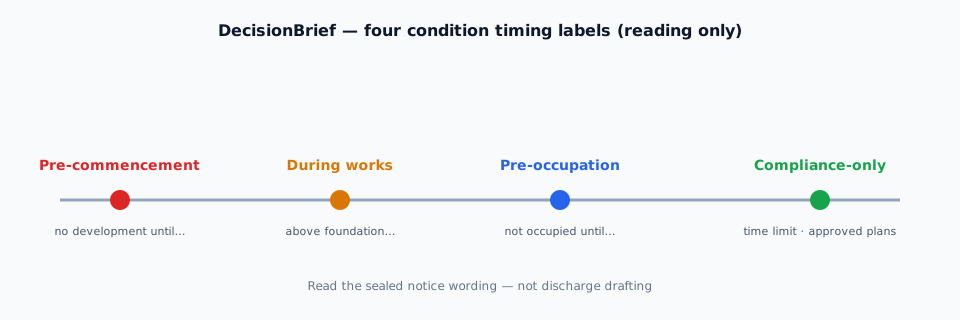
Condition 1 on the York sample is the standard three-year time limit. See how DecisionBrief classifies it as compliance-only alongside pre-commencement and pre-occupation items.
Standard three-year wording (reading only)
On a full planning permission, condition 1 often reads along these lines:
“The development shall be begun not later than the expiration of three years from the date of this permission.”
Variations appear: “commenced within three years”, “begun before the expiration of three years”, or “implemented within three years”. Always quote the numbered condition on the sealed notice — do not assume the standard form.
Section 91 of the Town and Country Planning Act 1990 is the statutory backdrop for default time limits. This guide cites it as public context only — not advice on whether your permission has lapsed or whether specific works count as “begun”.
Bespoke time limits
Authorities sometimes impose shorter or longer periods — two years for a retail unit, five years for long-lead infrastructure, or a date tied to a phasing plan. Read the exact words:
- Clock start — “from the date of this permission”, “from the date of this notice”, or a named committee date.
- What must happen — “begun”, “commenced”, “implemented”, or “submitted” (outline permissions may time-limit reserved-matters submission instead — see reserved matters on outline permission).
- Phasing — separate time limits per phase may appear as multiple numbered conditions.
Time limit is not pre-commencement
A time-limit condition sets when development must start by. A pre-commencement condition sets what must be approved before any start. Both can bind the same project:
- Compliance-only — “begun within three years” (time limit).
- Pre-commencement — “no development shall take place until the CEMP is approved” (stop until approval).
Submitting discharge applications does not typically extend the time-limit clock. Programming a site requires reading both the time limit and every pre-commencement stop — see pre-commencement vs pre-occupation and how to read condition timing.
A short reading checklist
-
Open the sealed decision notice (not only the officer report). Note the application reference and decision date.
-
Find condition 1 (or the first numbered condition) — quote the time-limit wording exactly.
-
Note the clock start and the verb — “begun”, “commenced”, “implemented”, or “submitted” (outline).
-
Classify separately from pre-commencement stops — time limit is usually compliance-only; pre-commencement items may still block the first lawful start.
-
Do not invent renewals or extensions. If the clock is tight, that is a matter for professional advice — not something DecisionBrief decides.
What a £79 DecisionBrief PDF is (and is not)
You paste the public URL of a named UK planning decision notice. We send a PDF in 24 hours that states the permission in plain English, lists every numbered condition we can source, classifies each with DecisionBrief’s timing labels, and cites the council wording so you can see the trigger. Neighbour personal names are redacted. If the notice is thin, the PDF says so. If we cannot read a public decision, we refund. We do not invent conditions.
What it is not
- Not planning advice. We do not say whether the permission is implementable, lawful, or a good idea — or whether specific works constitute commencement.
- Not discharge drafting. We do not write renewal applications or approval-of-details packs.
- Not a search engine. You already have the notice; we read the one you send.
Order a £79 sourced reading See the York sample first
Questions
What is the standard time limit on a full planning permission?
Many UK full permissions include a condition that development must be begun within three years from the date of the permission. The exact wording on the sealed notice is what binds — read condition 1 and quote it. DecisionBrief classifies time-limit conditions as compliance-only; we do not advise whether specific works constitute commencement.
Does submitting a discharge application extend the time limit?
No. A discharge or approval-of-details application does not typically extend the implementation clock on the face of the condition. The time-limit wording stands unless the notice or a separate legal instrument says otherwise. If you need advice on renewal or extension, instruct a planning consultant or solicitor.
Is a time-limit condition the same as pre-commencement?
No. A time limit sets when development must be begun by — it is usually classified compliance-only. Pre-commencement conditions stop development until something is submitted and approved. Both can appear on the same notice. Read each numbered condition separately — see pre-commencement vs pre-occupation.
When does the clock start?
Read the condition. Typical wording runs from “the date of this permission” or “the date of this notice”. The decision notice date and any committee resolution date may differ — quote the condition, do not guess.
Is this planning advice?
No. This guide and the £79 PDF are sourced readings of public notices. The council’s decision notice remains the legal document. If you need advice, instruct a planning consultant or solicitor.
Will you write the discharge applications?
No. We classify the conditions and cite the wording. We do not prepare or lodge an application for approval of details reserved by condition.
Informational reading guide only. Sources: Planning Portal — conditions and obligations; GOV.UK — Use of planning conditions. Last reviewed 21 September 2026. DecisionBrief is not City of York Council and is not the Planning Portal.