United Kingdom · guide · 23 September 2026
How to read contamination conditions on planning decision notices: the four-stage sequence
Brownfield decision notices often carry one long numbered condition with four limbs — desk study, site investigation, remediation strategy, verification report — each with a different timing trigger. The expensive mix-up is treating the whole paragraph as one pre-commencement gate, or assuming Phase II is always required. This guide is reading literacy: how to walk the sequence on the sealed notice, and what DecisionBrief does with it.
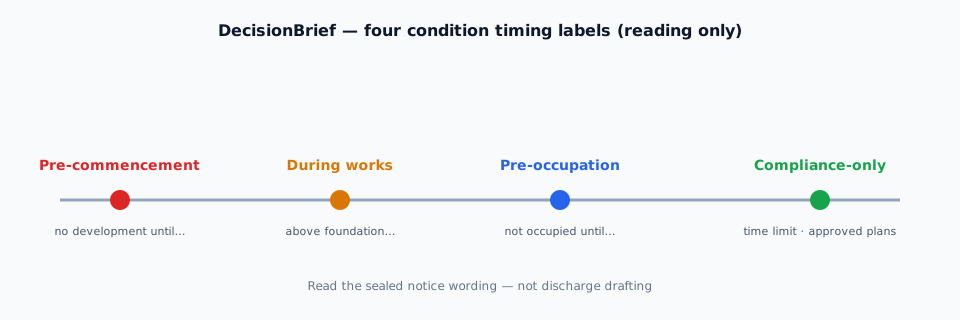
The four-stage sequence — read each limb separately
Model contamination conditions on UK decision notices typically follow a familiar sequence drawn from Environment Agency and local authority guidance:
- Phase I desk study / preliminary risk assessment — historical land use and conceptual site model.
- Phase II site investigation — intrusive investigation, sampling, and refined risk assessment — often phrased “if required” after Phase I.
- Remediation strategy — method to make the site suitable; may require approval before remediation works.
- Verification report — confirms remediation was carried out as approved; often due after works or at completion.
All four may sit under one condition number — a “super-condition”. Your programming task is to split the limbs and classify each trigger: pre-commencement, during works, post-completion, or contingency. See how to read condition timing for the four labels.
Typical wording patterns by stage
Phase I — usually pre-commencement
“No development shall commence until a Phase I desk study / preliminary risk assessment has been submitted to and approved in writing by the Local Planning Authority.”
This limb typically needs a formal application for approval of details reserved by condition — often called a discharge. Read the exact trigger: “prior to commencement”, “no development until… approved”, or similar. See which conditions need a discharge application.
Phase II — pre-commencement if required
“If the Phase I report identifies the need for further investigation, a Phase II site investigation and refined risk assessment shall be submitted to and approved in writing prior to commencement of development.”
The “if required” limb is conditional on Phase I findings — not automatic on every site. DecisionBrief cites the wording; we do not advise whether your Phase I triggers Phase II.
Remediation strategy — often pre-commencement or during works
“If contamination is identified, a remediation strategy shall be submitted to and approved in writing before any remediation works are carried out on site.”
Some notices require strategy approval before any development commences; others allow commencement of non-contaminated areas while strategy is prepared. Read the sealed notice — do not assume from the topic heading.
Verification — often post-completion
“Following completion of measures identified in the approved remediation strategy, a verification report shall be submitted to and approved in writing by the Local Planning Authority within four weeks of completion of remediation.”
Verification is often compliance-only in timing effect — it does not block start, but it is still binding once remediation occurs.
Unexpected contamination — a different animal
Many notices also carry a contingency limb — separate from the four-stage front-loaded sequence. On the City of York sample (25/01211/FUL, 45 Hempland Lane), condition 13 reads:
“In the event that unexpected contamination is found at any time when carrying out the approved development, it must be reported in writing immediately to the Local Planning Authority. An investigation and risk assessment must be undertaken and, if remediation is necessary, a remediation strategy must be prepared, which is subject to approval in writing by the Local Planning Authority. Following completion of measures identified in the approved remediation strategy, a verification report must be submitted to and approved by the Local Planning Authority.”
DecisionBrief classifies this as compliance-only for commencement purposes: it is not a barrier to starting. It bites only if unexpected contamination is found during the works. The mini-sequence inside (investigate → remediate → verify) mirrors the four-stage pattern but on a contingency trigger. See the York Hempland sample for the full condition list.
| Limb on sealed notice | Typical timing | Discharge on wording alone? |
|---|---|---|
| Phase I desk study — submit and approve before commencement | Pre-commencement | Usually yes — reserved details |
| Phase II — if required, approve before commencement | Pre-commencement (conditional) | Usually yes when triggered |
| Remediation strategy — approve before remediation works | Pre-commencement or during works | Usually yes — read trigger line |
| Verification report — after remediation complete | Post-completion / compliance | Often yes — submit and approve wording |
| Unexpected contamination — if found during works | Contingency — compliance-only for start | Mixed — bites only if triggered |
Super-condition literacy — one number, many triggers
Contamination conditions are a common example of a super-condition: multiple limbs under one condition number with different timing. When programming a site:
- Quote each limb separately — do not collapse to “contamination condition = pre-comm”.
- Map discharge submissions to the limbs that say “submitted to and approved in writing”.
- Keep unexpected contamination in a separate mental bucket — it is not part of the front-loaded sequence unless triggered.
- Cross-check the officer report only after the sealed notice — see decision notice vs officer report. The York sample officer report contemplated site-investigation conditions that are not in the numbered list; DecisionBrief does not add them.
What DecisionBrief does (and does not do)
The £79 sourced PDF lists every numbered condition we can source from the sealed notice, classifies each limb’s trigger timing where the wording supports it, and cites the council text so you can see whether the line describes reserved details or compliance-only duty. We do not write desk studies, site investigations, remediation strategies, or verification reports. We do not lodge discharge applications or advise on remediation design.
£79 one-off · one named notice · PDF in 24 hours
Order a £79 sourced reading See the York sample first
Related guides
- Which conditions need a discharge application — submit-and-approve wording checklist.
- How to read condition timing — four labels with York wording patterns.
- Pre-commencement vs pre-occupation — the two triggers applicants mix up most often.
- Informatives vs numbered conditions — contamination notes in informatives are not numbered conditions.
Questions
Do I need all four contamination stages on every brownfield site?
Not always. Phase I desk study is usually the first gate. Phase II site investigation follows only if the desk study or condition wording requires it — often phrased “if required”. Remediation and verification limbs bite only if contamination is confirmed. Read the sealed notice limbs; DecisionBrief classifies triggers and cites wording.
Is unexpected contamination a pre-commencement condition?
Usually no. Unexpected contamination wording is a contingency — it bites only if contamination not previously identified is found during the approved development. It does not block lawful commencement on its own. City of York 25/01211/FUL condition 13 is a worked example on the DecisionBrief sample.
Does a contamination condition always need a discharge application?
Often yes for pre-commencement limbs that require reports to be submitted and approved in writing — Phase I, Phase II if required, and remediation strategy approval. Verification may be post-completion. Unexpected contamination contingency wording may mix submit-and-approve steps that bite only when triggered. See the discharge checklist guide.
Will DecisionBrief write Phase I or remediation reports?
No. We classify conditions and cite council wording on the £79 sourced PDF. We do not prepare desk studies, site investigations, remediation strategies, or verification reports.
Is this planning advice?
No. This guide and the £79 PDF are sourced readings of public notices. The council's decision notice remains the legal document. If you need contamination or planning advice, instruct a consultant or solicitor.
Sources cited on this page: GOV.UK — Use of planning conditions; Environment Agency land contamination risk management guidance (signposted in officer reports); DecisionBrief sample for City of York 25/01211/FUL, 45 Hempland Lane (condition 13). Last reviewed 23 September 2026. DecisionBrief is not a local planning authority.